



What is FAIMS?
Field Asymmetric Ion Mobility Spectrometry (FAIMS) is an atmospheric-pressure technique that separates ions based on how they behave under alternating high and low electric fields.
Acting as an additional, orthogonal separation layer alongside LC and MS, FAIMS enables real-time ion filtering before mass analysis. Positioned between the electrospray ionization (ESI) source and the MS, it selectively transmits ions of interest - effectively simplifying complex samples and enhancing downstream detection.
In a hurry? Skip to TL;DR.
Key advantages of FAIMS
FAIMS delivers cleaner spectra and deeper insights by actively removing chemical noise and interfering species. The result is improved dynamic range, enhanced sensitivity, and more reliable detection of low-abundance analytes.
By selectively transmitting optimal ion populations - such as preferred peptide charge states - FAIMS increases identification rates and confidence in results. The boost in signal-to-noise also drives lower limits of detection (LOD) and limits of quantification (LOQ), making it a powerful tool for high-complexity workflows.
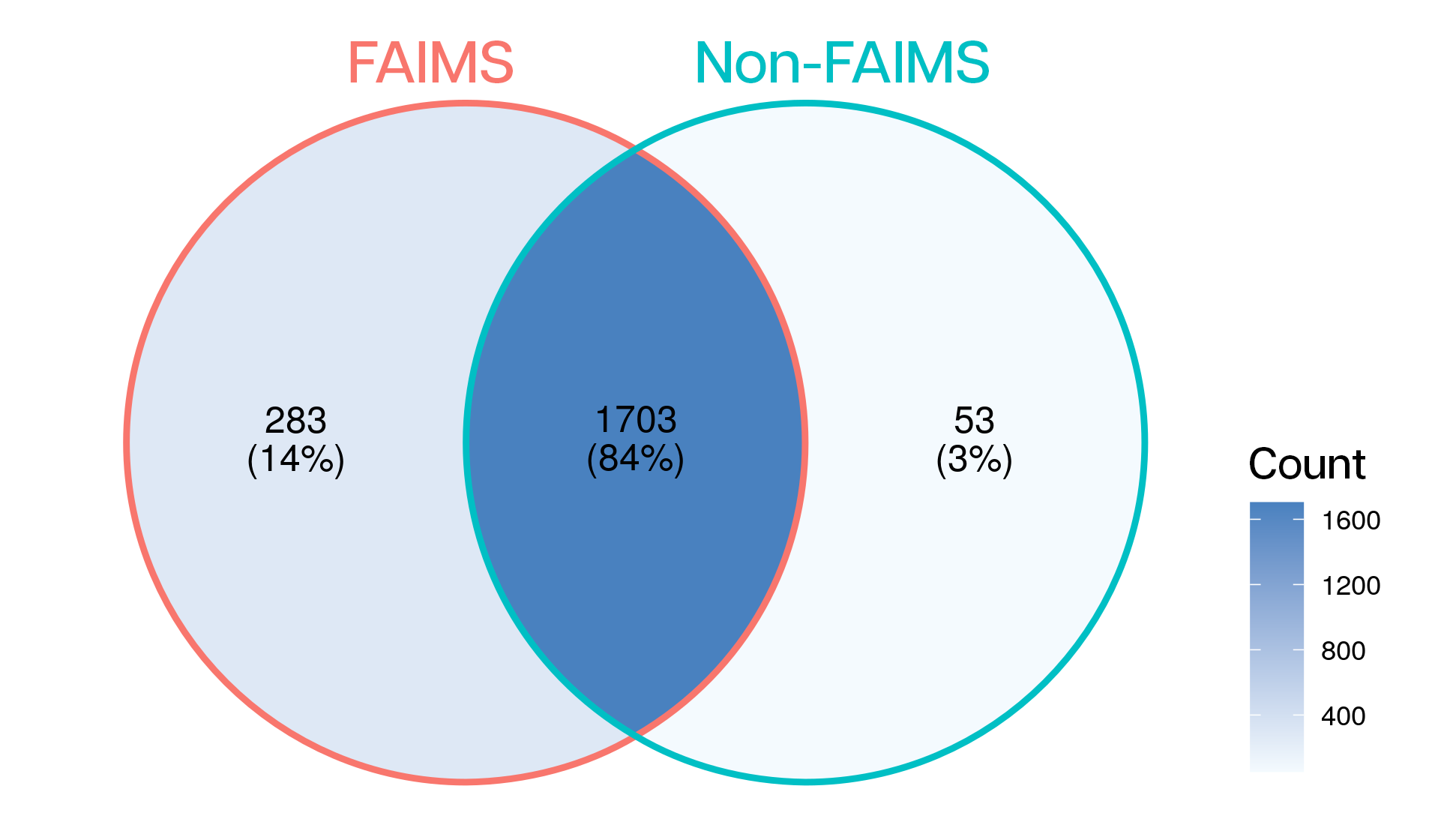
Figure 1. HeLa Protein Digest protein count on Vanquish Neo UHPLC coupled with Thermo Scientific Orbitrap™ Eclipse™ Tribrid™ MS, with versus without FAIMS. 20 μm ID x 360 μm OD x 50 mm length Trajan CB Emitters, gold distal coated (GDC) PK5 (part number 63240100) were used.
Selecting the right emitter for FAIMS technique
One critical but often overlooked factor in FAIMS-MS performance is the electrospray emitter. This small component plays a major role in ion transmission efficiency, spray stability, and overall data quality.
While stainless steel emitters are commonly used due to their durability and ease of handling, the material can introduce limitations when paired with FAIMS. Challenges such as restricted positioning relative to the FAIMS inlet and increased risk of electrical discharge can impact performance.
Why distal coated glass emitters perform better for FAIMS
-
Closer positioning to the FAIMS interface
Distal coated glass emitters can be positioned closer to the FAIMS inlet without increasing the risk of electrical arcing. This improved proximity enhances ionization efficiency and supports stronger signal transmission. -
Reduced risk of electrical discharge
The uncoated glass tip helps minimize unwanted arcing events, leading to a more stable spray and improved instrument reliability during operation. - Improved protein and peptide detection
More efficient ionization translates directly into better sensitivity, particularly for low-abundance peptides and proteins that are often difficult to detect. - Greater reproducibility across runs
Stable spray conditions reduce variability, improving consistency in quantitative workflows and delivering lower coefficients of variation (CV).
TL;DR
Conclusion
FAIMS has become a powerful addition to modern mass spectrometry workflows, delivering higher selectivity, improved sensitivity, and deeper analytical coverage.
However, achieving its full potential depends on optimizing the entire ionization and transmission pathway, including emitter selection.
Switching from stainless steel to distal coated glass emitters enables closer, more stable positioning at the FAIMS interface. This simple change can significantly improve detection sensitivity, increase protein identification rates, and enhance reproducibility. For researchers pushing the limits of performance, small hardware choices can deliver meaningful analytical gains.
Make the right choice
Request a FREE trial of gold distal coated (GDC) Trajan CB Emitters >
References